laravel-flow
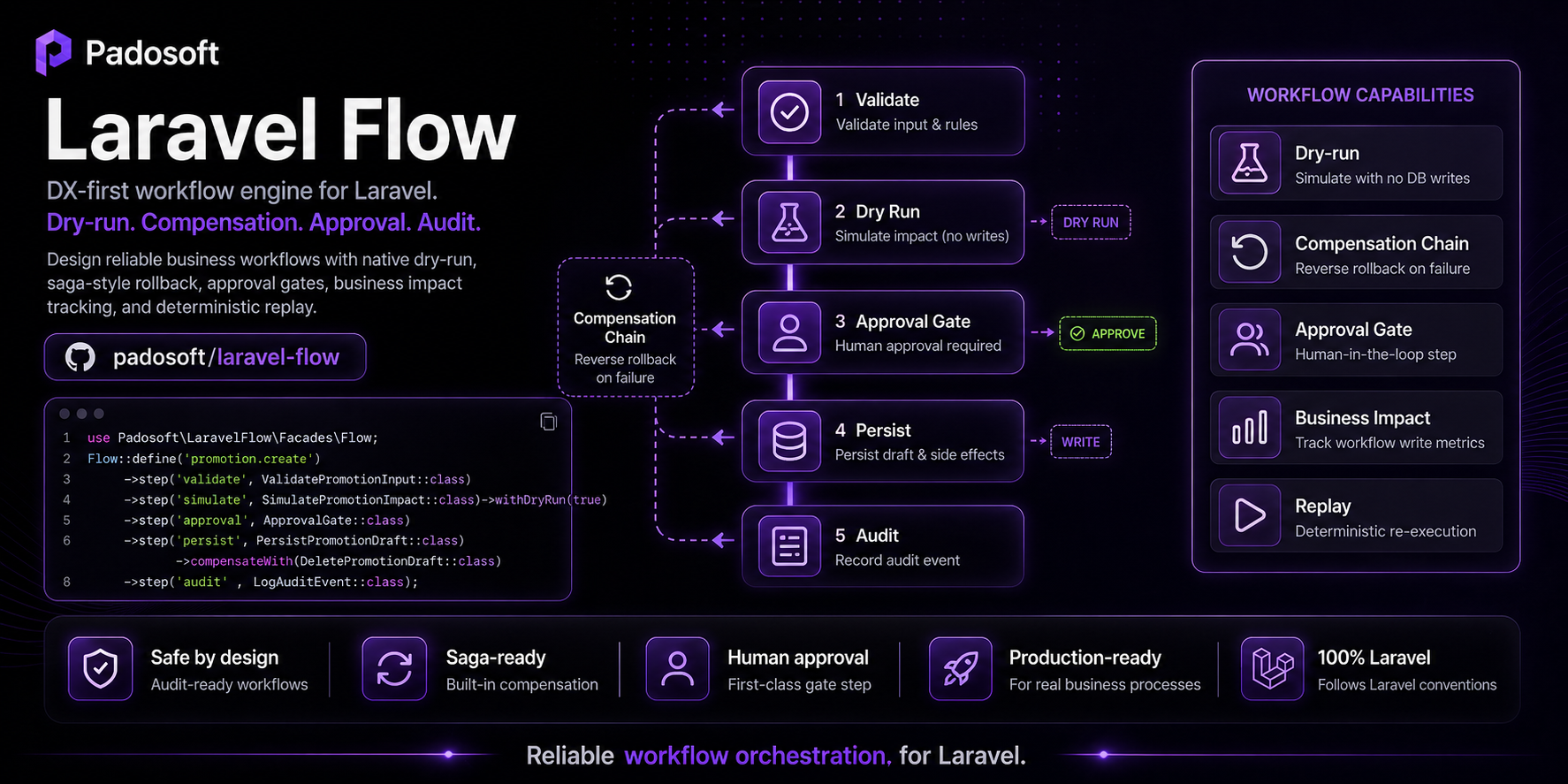





laravel-flow is the saga engine Laravel never shipped.
Define multi-step business workflows in one fluent surface a junior dev reads in 30 seconds, then get
native dry-run, reverse-order compensation, approval gates, signed webhook delivery and an immutable
audit trail — synchronous and in-memory by default, with opt-in DB persistence and queues. No
external workflow cluster, no new service to operate. It lives inside the Laravel app you already run.
In five minutes you’ll know exactly what this package is, the problem it solves, why it beats every
“just chain some jobs” alternative, and where to click next. Every other page goes deeper — this one
gives you the whole picture.
What it is — in one minute
Laravel apps constantly orchestrate multi-step business workflows: validate, simulate, write a DB
row, queue a job, call a vendor API, get a manager’s sign-off. The framework gives you Bus::chain()
for sequence, jobs for async and transaction() for atomicity — but none of them ship with dry-run,
reverse-order saga compensation, approval gates or a single fluent surface that a new
teammate can read at a glance.
laravel-flow is that surface. You declare the flow once and the engine handles the hard parts:
- Define readable flows —
Flow::define()->withInput([...])->step(...)->register()with
container-resolved, DI’d, stack-traceable handler classes (never closures). - Simulate before you commit —
Flow::dryRun()invokes dry-run-aware steps so they can project
business impact, skips the rest, and writes nothing to the database. - Roll back like a saga — when step N fails, the engine walks completed steps N-1 → 1 calling each
compensateWith()compensator, in reverse order by default. - Govern and observe — approval gates that pause/resume/reject runs, signed webhook outbox delivery,
an event-driven and append-only audit trail, and headless dashboard read contracts.
In one line: the DX-first workflow / saga / compensation engine for Laravel — dry-run, reverse-order
rollback, approvals and audit, inside your own app, with zero external workflow service.
The problem it solves
Every team that outgrows “just chain the jobs” hits the same wall: no preview, no predictable rollback,
no sign-off, no audit. Here is the gap this package closes.
| Without laravel-flow | With laravel-flow |
|---|---|
| You hand-roll a separate “preview” code path so users can see impact before committing. | Native dry-run — Flow::dryRun() projects business impact and writes no run, step, audit or compensator rows. |
| Step 3 fails after steps 1 and 2 already wrote rows — and cleanup is ad-hoc, best-effort, or forgotten. | Reverse-order saga compensation — compensateWith() walks completed steps backwards, predictably, every run. |
| A manual sign-off means a bespoke “pending” table, tokens and resume logic you build and secure yourself. | Approval gates pause the run, issue a hashed one-time token, and Flow::resume() / Flow::reject() continue or compensate. |
| Notifying downstream systems means scattering HTTP calls and praying transient failures don’t drop events. | Signed webhook outbox persists lifecycle rows and flow:deliver-webhooks retries with backoff and an HMAC signature. |
| “Who did what, when, with which inputs?” lives in scattered logs an auditor can’t trust. | Event-driven + append-only audit — FlowStep* / FlowCompensated events plus immutable flow_audit rows. |
| Workflow tooling means standing up Temporal or Step Functions — a new service, cluster and on-call surface. | Runs inside your Laravel app and DB. In-memory by default; persistence and queues are opt-in flags. |
| Secrets leak into stored payloads and exception text. | Configurable JSON redaction scrubs input/output/business_impact/payload/actor before storage; engine error text is sanitized. |
Who it’s for
Order, promotion, billing, onboarding and fulfillment flows that coordinate several steps in one request or job — with DI, events and Eloquent-compatible persistence you already know.
“Simulate this promotion / refund / migration before applying it” becomes a first-class Flow::dryRun() call that projects business impact and touches nothing.
Append-only audit rows, manual approval gates, redacted payloads and signed webhooks give auditors the who/what/when/which-inputs trail they ask for.
Headless dashboard read contracts, deny-by-default authorization, retention pruning and a companion admin UI — operate flows without bolting a workflow cluster onto your stack.
Why it’s different — the moats
Plenty of tools cover some of this. None ship the whole set as one fluent, Laravel-native, self-hosted surface.
->withDryRun(true) per handler. In dry mode the engine invokes dry-run-aware steps so they can project impact and self-skips the rest — no parallel “preview” code path to maintain, and zero DB writes.
When step N fails, the engine walks completed steps N-1 → 1 calling each FlowCompensator. Predictable rollback every time; opt-in parallel batching for independent, idempotent compensators.
approvalGate('manager') pauses the run, emits FlowPaused, and issues a hashed one-time token. Flow::resume() continues from the next step; Flow::reject() compensates — both under a per-run lock.
Lifecycle rows for flow.completed/failed/paused/resumed persist inside engine transactions; flow:deliver-webhooks signs each payload with X-Laravel-Flow-Signature and retries transient failures with backoff.
FlowStep* / FlowCompensated events route to your logger, DB or metrics; persisted flow_audit rows are blocked from update/delete at runtime — flow:prune is the only deletion path.
step('persist', PersistPromotion::class) — class-based handlers get DI, type hints and real stack traces, and survive serialization on queued workers. Strict withInput() validation fails fast on a missing key.
The engine runs synchronously in memory with zero migrations. Flip persistence.enabled for flow_runs/flow_run_nodes/flow_audit, correlation/idempotency keys, idempotent run reuse and retention pruning.
FlowDashboardReadModel returns paginated, immutable DTOs for runs, approvals, outbox and KPIs; DashboardActionAuthorizer is deny-by-default. The package stays headless; a companion app builds the UI.
Every class is @api (covered) or @internal; a contract test pins class names, methods and constants so a patch can’t silently rename or remove the public API. Redaction scrubs secrets before storage.
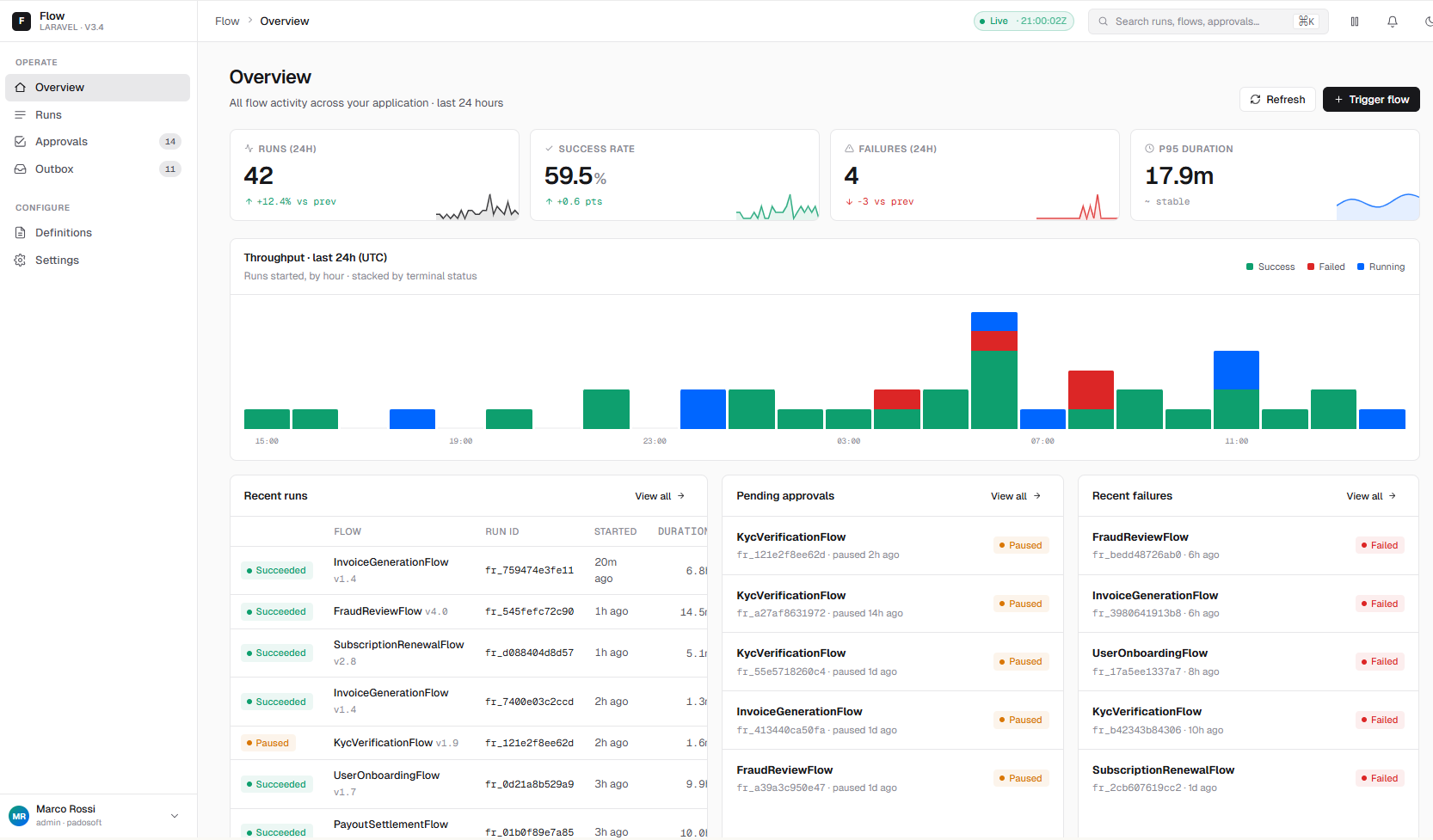
See it: the companion admin panel
The package itself is headless — there is no embedded UI. A full-featured web admin panel ships
separately as padosoft/laravel-flow-admin, built on
the package’s stable headless dashboard contracts (FlowDashboardReadModel + DashboardActionAuthorizer).
It surfaces runs, approvals, failures, the webhook outbox and operational KPIs.
laravel-flow vs. the alternatives
| Capability | laravel-flow | Raw jobs / Bus::chain() |
Symfony Workflow | Temporal / AWS Step Functions |
|---|---|---|---|---|
| Native dry-run with no persistence writes | ✅ | ❌ | ❌ | ❌ |
| Reverse-order saga compensation, built in | ✅ | ❌ | ➖ | ➖ |
| Resumable approval gate as a step type | ✅ | ❌ | ➖ | ➖ |
| Signed webhook outbox delivery | ✅ | ❌ | ❌ | ➖ |
| Container-resolved PHP handlers (DI + stack traces) | ✅ | ✅ | ✅ | ❌ |
| Append-only audit + event hooks | ✅ | ➖ | ✅ | ✅ |
| In-memory default, opt-in app-DB persistence | ✅ | ✅ | ➖ | ❌ |
| Runs inside your Laravel app, no external service | ✅ | ✅ | ✅ | ❌ |
Legend: ✅ built-in · ➖ partial / manual / via a different model · ❌ not available.
Snapshot checked against Durable Workflow, Symfony Workflow, Temporal and AWS Step Functions docs (2026-05-05).
If you already run Temporal or Step Functions and need their queue/replay/redrive guarantees today, use them.
→ Full competitor breakdown — the README carries the detailed 20-row matrix.
How it fits together
You register a FlowDefinition once; Flow::execute() (or dryRun() / dispatch()) iterates its steps
through the engine. A failure walks completed steps backwards through their compensators, and every run
resolves to a single FlowRun result.
Dry-runs invoke dry-run-aware steps and write nothing. When persistence is enabled, non-dry-run executions
write runs, steps and (with audit_trail_enabled) append-only audit rows.
Start in 30 seconds
Install the package
composer require padosoft/laravel-flow
# optional — the engine works with defaults:
php artisan vendor:publish --tag=laravel-flow-config
The in-memory, synchronous engine works immediately — no migrations required.
Define a flow with a dry-run step and a compensator
use Padosoft\LaravelFlow\Facades\Flow;

Flow::define('promotion.create')
    ->withInput(['brand', 'discount_pct', 'starts_at', 'ends_at'])
    ->step('validate', ValidatePromotionInput::class)
    ->step('simulate', SimulatePromotionImpact::class)
        ->withDryRun(true)
    ->step('persist', PersistPromotion::class)
        ->compensateWith(ReversePromotion::class)
    ->register();
Execute for real, or simulate with zero writes
$run     = Flow::execute('promotion.create', $input);  // real execution
$preview = Flow::dryRun ('promotion.create', $input);  // simulate, no DB writes

// If a later step fails, $run->compensated === true and prior steps were rolled back.
→ Quickstart · → Installation · → Worked Example
Batteries included for AI-assisted development
This repo ships AI batteries — a CLAUDE.md working guide, an AGENTS.md workflow contract and
invocable .claude/skills/ encoding the TDD loop, the Copilot review loop, the docs-sync discipline and
the package coding rules. Open the package in Claude Code, Cursor, Copilot or Codex and your agent
already knows the house rules. The pack is opt-in: delete .claude/ if you don’t use it — nothing else
depends on it.
![dependabot[bot]](https://www.gravatar.com/avatar/48ea49be76d0c68403a7f3df87e3487d?d=mp&s=64)